

If you’re an indie artist, DJ, church, label, or event organizer, that choice affects cash flow, timing, packaging strategy, and what you’ll have in hand when it’s time to sell or distribute. The terms sound interchangeable, but they’re not. They describe two different manufacturing paths.
One quick note before getting into discs. The phrase duplication vs replication also shows up in a totally different world, especially in science and reproducibility debates, which is why some people get conflicting definitions when they search. The media-manufacturing meaning is the one most buyers need here, but the mixed usage is real, as noted in the overview of the replication crisis and cross-context usage of the term.
Your Project Is Finished What Is the Next Step
The next step is simple in theory and important in practice. You need to turn a finished digital master into a physical product that people can buy, keep, hand to a friend, or stock at a merch table.
That’s where the fork in the road appears. Duplication means recording your content onto blank recordable discs. Replication means manufacturing discs through an industrial pressing process. Both can get your album, sermon series, training material, or promo content into people’s hands. They just solve different problems.
For most creators, the smart decision starts with three questions:
- How many do you need right now
- How fast do you need them
- What risk are you trying to avoid
If your main risk is over-ordering, duplication usually makes more sense. If your main risk is having too high a unit cost on a large release, replication usually makes more sense.
Start with the release plan, not the format
A lot of people ask the manufacturing question too early. They start with “Which one is better?” The better question is “What job do these discs need to do?”
A short-run tour batch has one job. A retail launch has another. A church media order that needs to go out every week has a different job again. Your answer should match the release plan, not someone else’s template.
If you’re still guessing at demand, physical media is inventory. Inventory guesses can get expensive.
What usually goes wrong
The most common mistake isn’t choosing the “wrong” technology. It’s ordering for the fantasy version of the release instead of the actual one.
- Bands overbuying for a first run because they hope every show will move product
- Organizations underplanning deadlines and discovering too late that mass manufacturing needs more setup
- Artists treating unit price as the only factor when timing and flexibility matter just as much
- Labels using a short-run process for a broad campaign when they already know demand will be there
The right move is to match the manufacturing method to the stage you’re in. Early-stage uncertainty rewards flexibility. Confirmed demand rewards scale.
What Is CD Duplication The Quick and Flexible Option
You finish the master on Tuesday, leave for a weekend run on Friday, and still want CDs on the merch table. That is the kind of job duplication is built for.
CD duplication records your files onto blank media such as CD-R or DVD-R. It skips the heavier factory setup used for pressed discs, so turnaround is usually faster and smaller quantities are easier to justify.

The main advantage is not just speed. It is risk control.
If demand is still uncertain, duplication lets you buy inventory in smaller steps instead of making one big guess. That matters for indie artists, churches, event organizers, and anyone else who needs discs for a specific use without tying up too much cash in boxes that may sit in storage.
Why duplication makes sense in real projects
Short runs are often the smart move when the goal is to learn something, hit a deadline, or support a narrow release window.
A band testing whether CDs still sell after shows does not need the lowest possible unit cost on a thousand copies. They need enough product for the next few dates, with room to reorder if fans buy. The same logic applies to conference handouts, advance promo copies, training discs, and recurring weekly media. In each case, flexibility is doing real financial work.
Duplication is a practical fit for:
- Tour merch when you want stock for the next leg, not six months of inventory
- Promo and outreach batches for radio, press, schools, churches, or events
- Recurring releases such as sermons, classes, and training materials
- Test runs when you are still figuring out packaging, audience demand, or sales pace
Where the trade-off shows up
Duplication works best when timing and quantity control matter more than squeezing every cent out of the unit price.
That rule is useful, but it is not absolute. I have seen artists duplicate more copies than the usual short-run advice would suggest because they needed them fast for a tour and could not wait on a longer production path. I have also seen groups choose duplication for ongoing smaller reorders because carrying less inventory mattered more than hitting the cheapest cost on paper.
The downside is straightforward. Once your quantity gets high and demand is already clear, duplication can become the more expensive way to fill the order.
A short-run-focused shop like Atlanta Disc is built for this kind of order profile, especially for artists, DJs, churches, and indie releases that need flexible quantities and faster turnaround instead of a large factory run.
What Is CD Replication The Mass Production Method
You finish an album, book a release show, and start planning a wider push. Maybe a distributor wants inventory, or a retailer asks for a real production run instead of a handful of CD-Rs. That is usually the point where replication enters the conversation.
Replication uses a manufacturing process built for scale. The data is prepared in a glass master, converted into stampers, and pressed into discs on a production line. The result is a factory-made disc rather than a recorded blank.
The reason replication costs more upfront is simple. The plant has to build the job before it can run the job. There is prepress work, mastering prep, stamper creation, and line setup. If you only need a small batch, that setup cost can eat up the budget fast. If you need enough units, the math starts to work in your favor.
That is why replication is tied to larger orders. It is not just a technical preference. It is a business decision based on whether your demand is proven enough to justify committing to volume.
Why artists choose replication
Replication makes the most sense when uncertainty is low and consistency matters more than flexibility.
A few common examples:
- Retail or distribution orders where you need a true factory-pressed product
- Funded releases with a clear sales plan, ad budget, or label support
- Catalog titles that keep selling steadily enough to support a larger run
- Institutional projects for schools, software, events, or training programs where quantities are known in advance
In those cases, replication is buying you predictability. You are trading a heavier setup and longer lead time for lower unit cost once the quantity is high enough.
Where replication can still be the wrong choice
Plenty of artists hear “replication is cheaper at scale” and assume they should stretch for it. Sometimes that is the wrong move.
If you are not sure how many copies you will sell, a big replicated run can leave you with money sitting in boxes. I have seen artists save a little on unit price and lose much more by overordering, especially when they changed artwork, updated credits, or shifted to new merch bundles a few months later.
That is the part spec sheets do not show. Cheap per unit is only cheap if the units move.
When breaking the rule makes sense
The usual advice is still useful. Small uncertain run, duplicate. Large proven run, replicate. But real orders are messier than that.
A higher-quantity duplication order can still be the smart call if the deadline is tight, the tour starts soon, or you want to stay light on inventory. A smaller replication run can make sense if a retail partner, distributor, or buyer specifically requires pressed discs and you already know where most of the units are going.
Use replication when the release plan is stable, demand is visible, and the savings from scale are real. Skip it when speed, flexibility, or caution matters more than manufacturing efficiency.
Duplication vs Replication Head-to-Head Comparison
The easiest way to compare duplication vs replication is to stop thinking about labels and start thinking about constraints. Quantity, deadline, budget, and release risk will make the answer pretty clear.
| Criterion | CD/DVD Duplication | CD/DVD Replication |
|---|---|---|
| Process | Data is recorded onto blank recordable discs such as CD-R or DVD-R | Discs are manufactured through glass mastering and pressing |
| Best fit | Short runs, test batches, merch, promos, recurring small orders | Large runs, retail campaigns, broad distribution |
| Typical quantity guidance | Commonly cited from about 1 to 1,500, with under 500 often the most cost-effective use case | Often described as the mass-manufacturing option for over 1,000 discs |
| Setup | Light setup | Heavy setup |
| Turnaround style | Faster and more flexible | Slower upfront, efficient once manufacturing starts |
| Per-unit economics | Strong for small quantities | Better at scale |
| Production speed once running | Not the main advantage | Replicated discs can be molded every 3 to 4 seconds |
| Best buyer mindset | “I need discs soon and I don’t want to overcommit” | “I know demand is there and I need volume efficiency” |

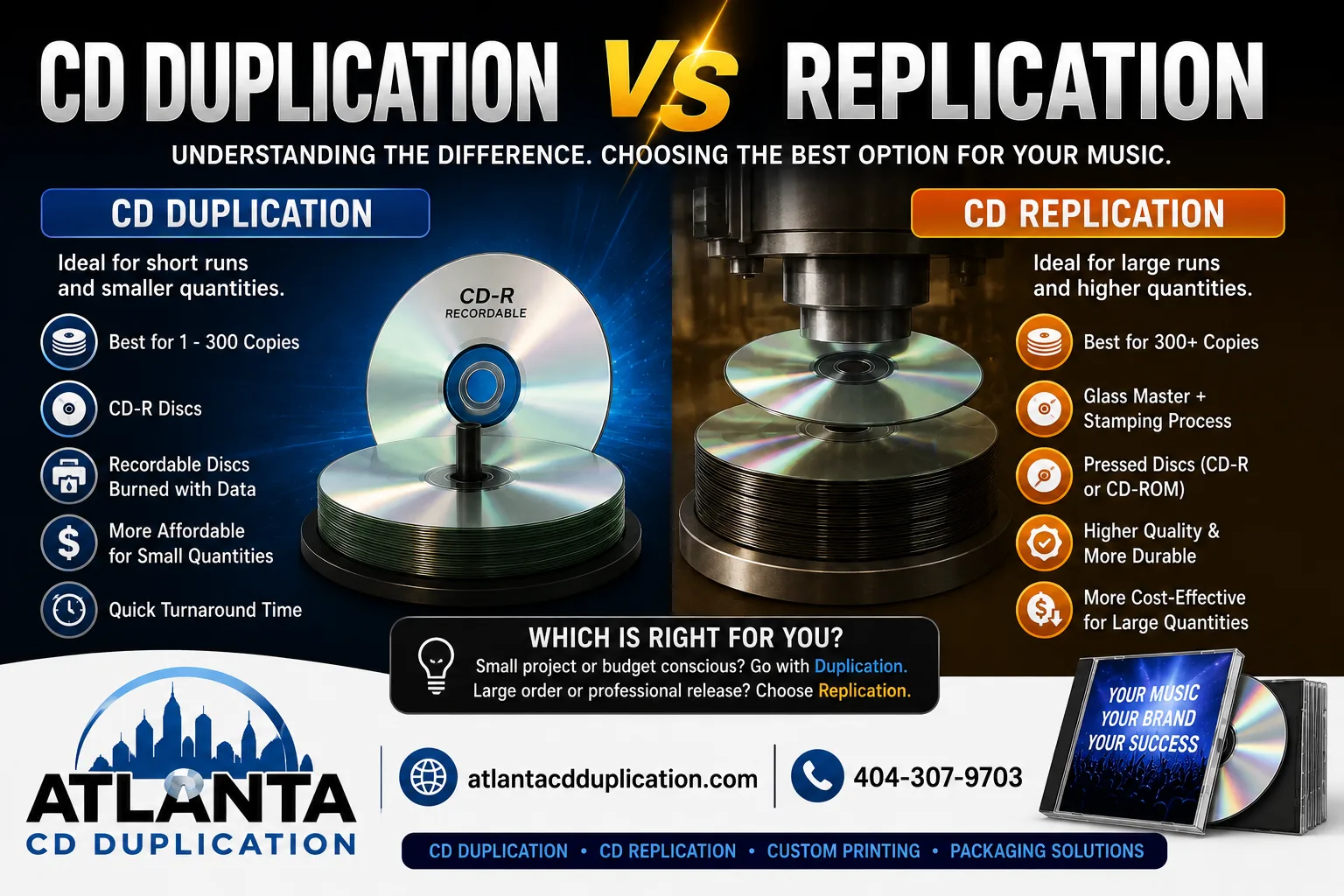
Cost is really a risk question
Most artists say they care most about cost. That’s true, but usually incomplete.
There are two kinds of cost. The first is what you pay the plant. The second is what you tie up in inventory that sits in your car trunk, studio closet, or church office because you ordered beyond real demand.
Duplication helps control that second cost. You can buy a smaller batch, get it out into the world, and respond to actual sales instead of projections. Replication becomes powerful when you’ve already crossed that uncertainty threshold and need the lower per-unit logic of larger-scale production.
The cheapest disc is not always the smartest order. The smartest order is the one that fits your actual sell-through plan.
Time often decides the job
A lot of projects are not decided by manufacturing theory. They’re decided by calendar reality.
If your release party is coming up, your conference date is fixed, or your ministry needs next week’s discs out the door, turnaround matters more than having the “ideal” manufacturing method on paper. Duplication is often the practical answer because it removes the long setup chain tied to pressing.
Later in the cycle, when deadlines loosen and order volume rises, replication gets more attractive.
To see the manufacturing contrast in action, this short clip gives a helpful visual reference:
Quality questions buyers actually ask
In day-to-day ordering, “quality” usually means one of three things:
- Playback confidence for the devices your audience still uses
- Presentation when the disc needs to feel like a polished retail item
- Consistency across the run
Replication has the feel of traditional commercial manufacturing. Duplication has the advantage of agility. For many indie projects, that agility is more valuable than trying to mirror a major-label workflow.
Files and packaging matter too
The manufacturing choice also affects how you plan the rest of the order.
A short-run project often pairs well with sleeves, wallets, slim cases, or event-ready packaging that keeps costs under control and moves quickly. A larger replication job tends to make more sense when the whole release package, including printed inserts and wider distribution planning, has already been nailed down.
If you’re stuck between the two, ask one practical question: are you still learning what buyers want, or are you scaling something you already know works?
Choosing the Right Method Real-World Scenarios
Real orders rarely arrive as neat textbook examples. They come in with deadlines, partial budgets, and a lot of “we think we need this many.”

Here’s how the duplication vs replication decision usually plays out in practice.
The band with a show this weekend
A local band finishes an EP and wants CDs on the merch table for a weekend run. They don’t know whether fans will buy ten per night or clear out the whole box. Their smartest move is usually duplication.
Why? Because the goal of that first batch isn’t manufacturing perfection at scale. The goal is to get something sellable into fans’ hands fast, without betting too much cash on an unproven number.
If the discs move, they can reorder. If they don’t, they haven’t buried their margin in inventory.
The church with recurring DVD needs
A church media team often has a different challenge. They may need DVDs regularly for sermons, classes, outreach, or shut-in ministry. Their need is not one giant national launch. Their need is a repeatable, manageable workflow.
That makes duplication attractive because it supports shorter-run cadence. The team can order in practical quantities, update content as needed, and avoid stockpiling material that may date quickly.
The rapper testing a mixtape release
A hip-hop artist dropping a mixtape often wants to test two things at once: demand and presentation.
Maybe the audience will buy a basic wallet package quickly because the music is hot. Maybe they’ll want something more collectible. In that situation, duplication gives room to learn before committing to a large manufacturing run. It’s also useful when the release is tied to a local event, club night, listening party, or street-team handoff where speed matters.
If you’re still testing the market, flexibility is an asset. You can always scale into a bigger manufacturing plan after the audience answers.
The indie label with a real rollout
An indie label planning a broad album launch is in a different category. If the release already has distribution, marketing, and reliable expected demand, patching together multiple short runs can create more friction than value.
That’s where replication usually earns its place. The label isn’t trying to learn whether buyers exist. They’re preparing for larger-volume distribution and want a manufacturing method built for that.
The smart exception cases
Some jobs break the standard advice, and that’s fine.
- Large quantity, brutal deadline: duplication may still win because timing is critical.
- Smaller launch, guaranteed audience: replication may still make sense if reorder risk is low and the release plan is locked.
- Mixed audience needs: some projects work best by starting with a short duplicated run for immediate demand, then moving to replication if sales justify it.
The best decisions usually come from honest forecasting. Not optimistic forecasting. Honest forecasting.
Your Project Roadmap Ordering With Atlanta Disc
You’ve finished the master, approved the artwork, and picked a release date. Now the job is to place an order that fits the plan you have, not the one you hope appears later.

Start with the first sell-through, not the lifetime total
The practical question is simple. How many discs can you realistically move in the first stretch of this release?
That number matters more than the total audience you want to reach someday. A singer-songwriter selling at weekend shows has a different risk profile than a label shipping to stores, even if both believe the album has room to grow.
If the first wave is modest or uncertain, duplication usually keeps the budget under control. If the demand is already lined up through preorders, retail, events, or a broader launch plan, replication can be the better production fit.
Match the manufacturing method to the date on the calendar
Deadlines decide more jobs than people expect.
A short runway changes the math because speed can matter more than squeezing every possible unit cost out of the order. If you need discs in hand for a tour start, release party, conference, or church event, duplication often gives you more breathing room. If the date is firm but still comfortably ahead, and the order size supports it, replication becomes easier to justify.
Be honest about inventory risk
This is usually the part that saves people money.
Extra discs are not a win if they sit in boxes for a year. On the other hand, ordering too few can be annoying if you know the audience is there and a reorder would interrupt momentum. The right choice depends on what kind of risk hurts more for your project: tying up cash in unsold stock, or paying again soon because the first run moved fast.
Ask a few direct questions:
- Am I filling known demand or testing demand
- Will these sell mostly at live events, online, or through distribution
- If this run sells out, can I reorder without hurting the release plan
- Does the packaging need to feel premium enough to support the selling price
Order for the next real milestone. That could be a month of shows, a release weekend, or a confirmed wholesale push.
A practical filter that works
Use this framework when you’re ready to place the order:
- Need a smaller run for merch, promos, or a first batch for fans. Duplication usually makes more financial sense.
- Need a larger quantity for a coordinated launch with reliable demand. Replication usually earns the extra setup.
- Need product fast and can’t miss the date. Duplication often wins, even if the quantity is higher than the usual rule of thumb.
- Need a polished retail-style run and already know it will move. Replication is often the cleaner long-term choice.
That last point is where artists sometimes outgrow the standard advice. A project does not have to follow a rigid quantity cutoff. If the audience is proven and the release plan is locked, breaking the usual rule can be smart.
Atlanta Disc handles the practical side of that decision: quantity, packaging, print options, and turnaround. If you already know your deadline, rough unit count, and how you plan to sell the discs, you have enough information to start the order without overcomplicating it.